Containers
This page is the durable developer and release contract for OmniBioAI containers. It describes the architecture and evidence required for a container to be useful in development or trustworthy in production. Exact plugin commands remain owned by the plugin repository and its README.
Overview
Containers provide reproducible execution, dependency isolation, portability across heterogeneous compute environments, and a durable provenance boundary. They also let each plugin evolve on its own release cadence instead of forcing unrelated dependencies into one platform image.
The normal relationship is:
plugin source
  -> plugin Dockerfile
  -> OmniBioAI canonical base
  -> versioned image and immutable digest
  -> validated runtime execution
An image tag is a release selector; the digest is the immutable artifact identity. A completed build is not automatically a release: architecture, runtime behavior, metadata, supply-chain evidence, and the remote artifact must be checked at the level appropriate to the image.
Container architecture
OmniBioAI uses a layered model:
trusted upstream parent
  -> OmniBioAI canonical base
  -> plugin-specific image
  -> version tag / digest
  -> execution backend
Canonical bases contain the small, stable dependency denominator shared by a workload family. A child image contains the plugin's code and only its specific dependencies. This keeps rebuilds, vulnerability review, and failure isolation tractable. It also avoids a universal image carrying R, scientific Python, workflow engines, every model, and every native tool.
One plugin, one image identity
The contract is one plugin → one independently versioned image identity. Shared inheritance does not mean that plugins share a mutable runtime image. Each child must remain independently buildable, testable, versionable, publishable, and traceable to its source revision, parent, digest, and release evidence.
Use the first-party namespace and a stable plugin name, for example:
ghcr.io/omnibioai/omnibioai-plugin-<plugin-name>:1.0.0
Do not introduce production references under an individual developer or
legacy account namespace. Existing references outside
ghcr.io/omnibioai/* are migration material that must be verified by the
owning repository; this page does not make them canonical.
Choosing a canonical base
Choose the smallest established base that satisfies the plugin's common runtime requirements. Keep unusual or plugin-specific dependencies in the child image.
| Family | Canonical image | Primary use | Architecture/release state |
|---|---|---|---|
| Minimal Python | ghcr.io/omnibioai/omnibioai-runtime-python:1 | Lightweight Python plugins, connectors, API/reference integrations, and workloads without the scientific stack | linux/amd64 + linux/arm64; release verified |
| Scientific Python CPU | ghcr.io/omnibioai/omnibioai-base | NumPy, SciPy, pandas, scikit-learn, Scanpy, and heavy CPU/Tier-0 scientific Python workloads | Architectures validated; production multiarchitecture release pending |
| Minimal R | ghcr.io/omnibioai/omnibioai-runtime-r | Lightweight R workloads that do not require the full Bioconductor stack | linux/amd64 + linux/arm64; 1.0.0 release verified |
| Bioconductor | ghcr.io/omnibioai/omnibioai-base-bioconductor | Bioconductor-dependent genomics and bioinformatics workloads | R 4.4.2 / Bioconductor 3.20; linux/amd64 + linux/arm64; 1.0.0 release verified |
| Workflow/native bioinformatics | ghcr.io/omnibioai/omnibioai-base-workflow | Common native tools such as samtools, bcftools, bedtools, and tabix/bgzip | linux/amd64 + linux/arm64; 1.0.0 release verified |
| NVIDIA/CUDA GPU | ghcr.io/omnibioai/omnibioai-base-gpu | CUDA, GPU ML, GPU bioinformatics, and GPU inference/training where supported | Architecture-conditional; technically validated, production publication pending |
The Minimal Python release is 1.0.0, with 1.0 and 1 aliases. It is a
Python 3.12 slim-based runtime with no universal scientific stack, uses
non-root UID/GID 10001:10001, and has native Linux amd64 and arm64 release
evidence including SBOM and provenance. The current validated plugin
publication population is 119/119 release verified; that is implementation
status, not a permanent architecture requirement.
Minimal R is a reusable, non-root foundation for lightweight R workloads. Its 1.0.0 release is verified for native Linux amd64 and arm64. Use Bioconductor instead when the workload requires the Bioconductor package ecosystem rather than adding that dependency set to Minimal R.
The Bioconductor family is based on R 4.4.2 and Bioconductor 3.20. Its 1.0.0 release is verified for native Linux amd64 and arm64. It is a focused foundation, not a universal R environment; heavy or workload-specific packages remain in downstream images.
The Workflow/Native release is 1.0.0, with 1.0 and 1 aliases. Its
intentionally narrow toolset does not include Nextflow, Snakemake, Cromwell,
WDL, or CWL engines. Those belong in specialized images when required. Its
published release evidence includes native amd64 and arm64 manifests,
non-root execution, remote SPDX SBOM, remote SLSA provenance, and published
arm64 runtime validation.
The Scientific Python CPU family is the canonical target for the NumPy-2
scientific stack and heavy CPU/Tier-0 workloads. It is not interchangeable
with Minimal Python and is not a universal lightweight runtime. Source
hardening and ARM64/AMD64 validation are complete; production
multiarchitecture publication remains pending release authorization. Do not
describe it as release verified or treat a historical latest tag as a
current multi-platform release.
The GPU family is a validation-gated target, not a blanket promise that every CUDA image is portable. ARM64 GPU validation has been performed on DGX Spark/GB10 and AMD64 image build validation has been performed; production GHCR publication remains pending. Its supported architectures must follow actual NVIDIA/CUDA/framework support and runtime evidence.
Specialized compatibility bases may exist when technically justified, but they are not additional universal families. Keep unusual or plugin-specific dependencies in the child image.
Plugin image contract
A plugin Dockerfile should inherit a canonical base using an explicit release line, for example:
FROM ghcr.io/omnibioai/omnibioai-runtime-python:1

# Install only this plugin's reviewed, locked dependencies.
# Copy the plugin and configure its documented entry point.
Keep dependency inputs reviewable and locked. A child image should not add unrelated frameworks, reference databases, workflow engines, or development toolchains merely because they are convenient during development. Development images can exist separately when compilers or interactive tooling are needed.
The child release should record its parent identity, source revision, version, supported platforms, dependency lock, and validation results. A plugin's runtime contract should cover its entry point, input/output behavior, exit status, writable paths, user identity, network/TLS requirements, and any hardware requirement.
Platform-service containers
Platform services are distinct from plugin images and workflow execution containers. They include long-running API, application, control-plane, and other OmniBioAI service workloads. A service image has its own owner, runtime contract, version, digest, deployment context, and release evidence; service container counts must not be conflated with plugin or workflow counts.
Service images should use the smallest appropriate base family or a justified upstream parent, reproduce their dependencies, run with least privilege and non-root execution where technically feasible, and carry OCI metadata, SBOM, and provenance. Their release is not verified until architecture-appropriate runtime evidence and post-push remote registry evidence are available.
Workflow execution containers
Workflow definitions and their containers are related but not identical:
workflow definition
  -> task/process
  -> container image
  -> version/digest
  -> execution backend
OmniBioAI has 1,000+ workflows, but one workflow does not necessarily equal one image. Workflows may reuse common execution images, and an execution image may be first-party or a justified third-party image. Workflow registration or catalog presence is not release verification. Where the execution path supports it, record the exact image identity and immutable digest in execution provenance; see Reproducibility & Provenance for current platform limitations around tag and digest capture.
Multi-architecture standard
For applicable first-party CPU images, the standard is a single image identity with native child manifests for:
linux/amd64
linux/arm64
Buildx can assemble that manifest, and QEMU can help build or smoke-test a
foreign architecture. Neither fact proves that the image is a native runtime
for that architecture. Do not permanently force platform: linux/amd64 as a
substitute for ARM64 support, and never point both manifest entries at the
same architecture-specific image.
An upstream package or parent may make an architecture technically unsupported. In that case, record the exception as an explicit architecture constraint, show the upstream manifest evidence, and publish only the architectures genuinely supported. “Build passed under emulation” is not evidence that an architecture is supported.
GPU support is stricter: the upstream NVIDIA/CUDA dependency must support the architecture and the actual NVIDIA runtime must be tested on hardware. A CUDA filesystem, a successful build, or an import of PyTorch is insufficient.
Building and testing
Use the owning repository's workflow and Dockerfile as the command authority. The expected validation layers are:
- Dockerfile parse and dependency-resolution/build validation.
- Architecture inspection of the built image and manifest.
- Python startup and application/plugin import, where applicable.
pip checkfor Python images.- A functional plugin smoke test, not just an import test.
- Non-root execution and required writable-path checks.
- TLS/CA validation for images that contact HTTPS services.
- Architecture-specific runtime validation and release evidence.
Apple M4 and other Apple M-series machines provide native arm64 CPU validation and are useful for structural and architecture-neutral checks. Apple GPU/Metal/MPS is not NVIDIA CUDA and cannot validate a GPU image's CUDA behavior.
DGX Spark provides the intended native Linux arm64 + NVIDIA validation path: verify host and container architecture, NVIDIA Container Toolkit exposure, GPU visibility, CUDA availability, device enumeration, and an actual GPU operation. A real AMD64 NVIDIA host is required for authoritative AMD64 CUDA runtime validation. An AMD64 Buildx target alone proves only image buildability.
For a GPU smoke test, the minimum meaningful operation is equivalent to:
import torch

assert torch.cuda.is_available()
assert torch.cuda.device_count() >= 1
x = torch.ones((2, 2), device="cuda")
y = (x @ x).to("cpu")
assert y.tolist() == [[2.0, 2.0], [2.0, 2.0]]
print(torch.__version__, torch.version.cuda, torch.cuda.get_device_name(0))
Also record nvidia-smi or equivalent runtime evidence when available. A
GPU image that builds but cannot access a device is not GPU-runtime verified.
Versioning and reproducibility
Use semantic release tags such as:
1.0.0   exact release
1.0     compatible minor release alias
1       compatible major release alias
The exact version communicates the intended release; the digest identifies
the immutable artifact; aliases are convenience selectors that may move when
the release line advances. Production jobs should pin an exact version and,
where provenance matters, its digest. Do not use latest as the production
reproducibility mechanism. A latest tag may be intentionally absent.
Reproducible releases pin the upstream parent (preferably by digest), review and lock Python dependencies, record resolved native package versions, and capture source revision, version, supported architectures, and image sizes.
Production release verification contract
For applicable first-party production containers, RELEASE VERIFIED requires all of the following:
- a
linux/amd64image; - a
linux/arm64image; - an actual remote OCI index containing the required architectures;
- architecture-appropriate runtime smoke tests;
- reproducible, locked dependency state;
- OCI source metadata;
- OCI revision metadata;
- OCI version metadata;
- an SBOM;
- provenance or attestation;
- immutable digest evidence; and
- post-push remote manifest verification.
A successful Docker build is not RELEASE VERIFIED. A successful CI
workflow is not RELEASE VERIFIED. A workflow declaration such as
linux/amd64,linux/arm64 does not prove that the registry contains both
architectures; the remote OCI index is authoritative.
GPU and other specialized workloads may have justified architecture exceptions. Document the supported architectures and evidence explicitly rather than claiming native support for an unsupported platform.
Plugin container release factory
The Workbench Plugin Catalog registers 501 entries: 500
functional plugins plus the home display entry. The plugin container release
factory is the fleet-scale process that takes every entry in that inventory to
an explicit, evidence-backed outcome. It is not a bulk image build. Catalog
presence is not production release, and the objective is not to publish every
plugin: it is to account for the complete Workbench plugin inventory, with
every entry either RELEASE VERIFIED or recorded in an explicit state that
says why it is not.
Do not count something because it exists. Count it when it is verified.
The fleet denominator is therefore the complete plugin inventory, not the subset that happens to have an image. An entry that is not a container release candidate, such as a display entry, is accounted for with that explicit reason rather than dropped from the count. Progress is reported as entries accounted for, and release-verified plugins are a subset of that total.
Release lifecycle
Each plugin is evaluated independently and advances only while the evidence for the previous stage holds. Missing or failed evidence at any stage ends in an explicit blocker state, which still counts toward the inventory.
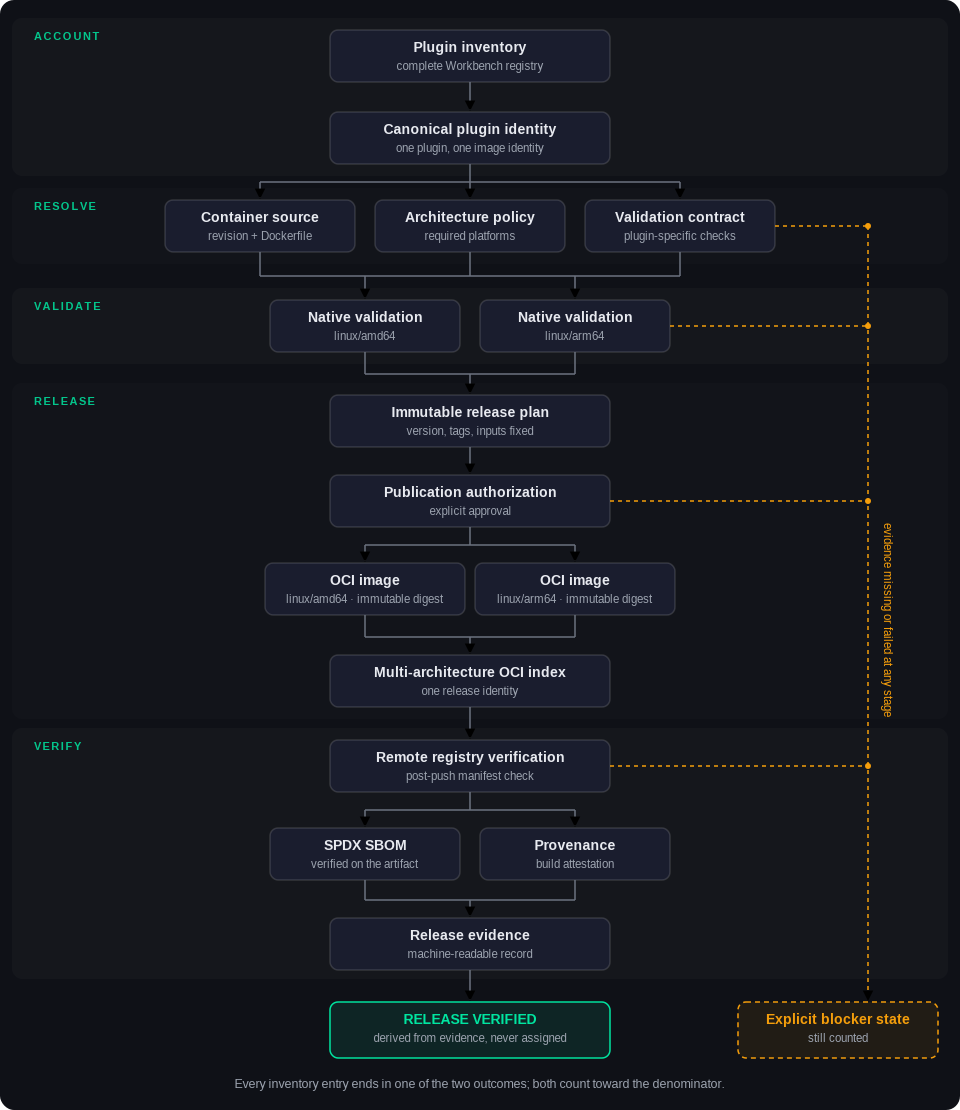
Text version of the diagram
               plugin inventory
                      |
            canonical plugin identity
                      |
    +-----------------+-----------------+
    |                 |                 |
 container        architecture      validation
 source +          policy            contract
 Dockerfile           |                 |
    +-----------------+-----------------+
                      |
         native validation per architecture
             linux/amd64    linux/arm64
                      |
       immutable release plan + authorization
                      |
    architecture-specific OCI images -> OCI index
                      |
     remote verification, SBOM, provenance
                      |
          machine-readable release evidence
                      |
               RELEASE VERIFIED
- Inventory and identity. The plugin is resolved from the inventory to one canonical plugin identity, consistent with one plugin, one image identity.
- Container source. The canonical source revision and Dockerfile for that identity are resolved. A plugin without a resolvable canonical container source stops here.
- Architecture policy. The required architectures are determined. CPU
plugins follow the multi-architecture standard:
independent native validation on
linux/amd64andlinux/arm64, where emulation does not count as native validation. GPU-specific or otherwise architecture-constrained plugins may have a narrower policy only when the constraint is explicit and justified by evidence. - Validation contract. A plugin-specific validation contract is selected (see below).
- Native validation. The contract is executed natively on each required architecture.
- Release plan and authorization. An immutable release plan fixes the version, tags, and inputs, and publication proceeds only with explicit authorization.
- Publication. Architecture-specific images are published by immutable digest and combined into one OCI image index, following Publishing to GHCR.
- Verification and evidence. The remote index, SBOM, and provenance are verified on the published artifact, and the results are recorded as machine-readable release evidence.
What does not count as a release
A plugin is not production released merely because any of the following exists: a Dockerfile, a successful Docker build, a registry package or tag, an architecture-specific image, a CI job, or a successful local run. Each is an input to the factory, not its result. Production release requires the complete applicable verification contract.
Validation contracts
Validation is plugin-specific. Starting a container is not validation, and a scientific plugin is not production validated because its container starts. A contract verifies behavior appropriate to the plugin, for example:
- an executable or version probe;
- runtime import or load of the plugin;
- architecture verification of the running container;
- a deterministic functional smoke test;
- a small scientific computation with known results; and
- verification of output structure and content.
The contract has its own identity so the release evidence records exactly which validation a release passed.
Release contract
For a plugin, the production release verification contract is satisfied by applicable evidence of:
- exact source identity and canonical Dockerfile identity;
- validation-contract identity;
- native validation on each required architecture;
- the immutable release plan and explicit publication authorization;
- architecture-specific immutable digests and the combined OCI index;
- post-push remote registry verification;
- an SPDX SBOM and build provenance/attestations (see SBOM, provenance, and scanning); and
- machine-readable release evidence tying these together.
RELEASE VERIFIED is derived from that evidence by the release state derivation; it is never a manually assigned label. If any required item is missing or fails, the plugin is not release verified.
Outcomes other than release
A plugin that does not reach RELEASE VERIFIED remains in the denominator
with an explicit, evidence-backed state; the controller never drops an entry
to shrink the count. This is also how the denominator itself is computed: it
is every entry in the 501-row plugin inventory, including entries with no
container to release. The home display entry, for example, is not
excluded — it is carried as NOT_CONTAINER_APPLICABLE.
Before native validation runs, inventory evaluation assigns one of:
READY_FOR_VALIDATION— container-applicable, no blocker, not yet validated.NOT_CONTAINER_APPLICABLE— the entry has no container to release.BLOCKED_CONTAINER_SOURCE— the canonical Dockerfile for the identity is missing or ambiguous.BLOCKED_ARCH_POLICY— the plugin hardcodes a platform or is a stub/placeholder image.BLOCKED_GPU_CLASSIFICATION— the plugin's GPU/CPU compute class could not be determined from evidence.BLOCKED_VALIDATION_CONTRACT— no complete validation contract exists for the identity.BLOCKED_IDENTITY_MAPPING— the identity is ambiguous across the workbench, tool-image, and TES catalogs.BLOCKED_IMAGE_IDENTITY— the intended image namespace conflicts with an existing image reference.BLOCKED_DEPENDENCY_POLICY— a parent image is pinned to a mutable tag (for example:latest) instead of an immutable reference.
Once validation and release planning begin, the release plane derives either
READY_FOR_RELEASE or a blocker from one of six fail-closed families:
VALIDATION_EVIDENCE (evidence missing, schema-invalid, mismatched across
architectures, non-native, stale, or a failed/blocked validation result),
RELEASE_PLAN (plan mismatch, immutable-tag collision, image-identity
conflict, or an unmet GPU validation requirement), AUTHORIZATION (no
explicit publication authorization naming the plan digest), INFRASTRUCTURE
(registry authentication), PUBLICATION (source drift, per-architecture
publication failure, index assembly, remote digest mismatch, remote
verification, or incomplete evidence), and SUPPLY_CHAIN (missing SBOM or
provenance). An authorized publication that is still in progress reports the
furthest pipeline stage it actually reached rather than a bare blocker:
PLANNED, PUBLICATION_AUTHORIZED, AMD64_PUBLISHED, ARM64_PUBLISHED,
OCI_INDEX_CREATED, REMOTE_VERIFIED, or SUPPLY_CHAIN_VERIFIED, before
RELEASE_VERIFIED itself.
Publication jobs must have the registry permissions required to publish their authorized package artifacts; see Publishing to GHCR.
Plugins, workflows, and execution
The factory releases plugin containers: each image is a plugin's executable capability and runtime. Workflow bundles are scientific workflow definitions, and the execution layer decides where and how a workload runs. A release-verified plugin image does not contain every tool that every workflow needs; see Workflow execution containers.
Tool container release factory
OmniBioAI maintains a catalog of scientific tool containers: execution environments for individual scientific tools, distributed as OCI images and as Apptainer/Singularity Image Format (SIF) files. A tool's presence in the catalog, an existing OCI image, an existing SIF, or a successful build does not by itself constitute a production release.
The tool container release factory turns an eligible tool definition into architecture-specific, validated, immutable, retrievable execution artifacts, and records why any tool or architecture did not get there. It specializes the production release verification contract for SIF-distributed scientific tools, and it applies the same counting rule as the plugin container release factory: a tool and architecture count when they are verified, not because an artifact exists.
A SIF that is release-complete has been executed on its release runner. That does not by itself establish operational SIF execution in a deployed OmniBioAI stack; deployment support is governed by Administrator Deployment.
Current implementation scale
The catalog currently holds more than 1,000 tool/SIF packages. That figure is an implementation metric, not part of the contract. Catalog membership is not release completion: readiness is evaluated per tool and per supported architecture, and artifacts published outside the factory carry no release-complete status until that tool and architecture pass the contract below.
Tool release lifecycle
Each tool advances separately for each architecture it supports, and only while the evidence for the previous stage holds. A failed gate or blocking decision at any stage ends in a recorded, fail-closed outcome that still counts toward the catalog.
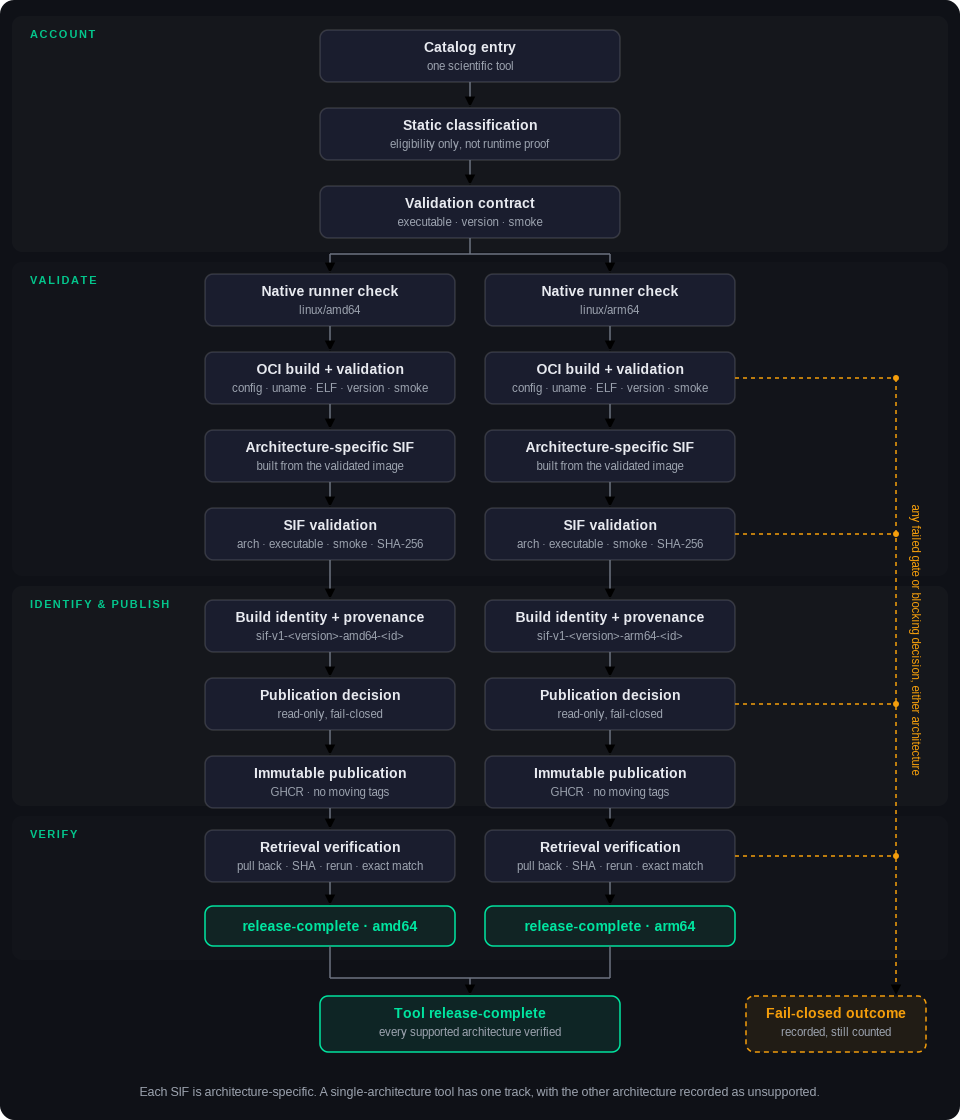
Text version of the diagram
catalog entry
  -> static classification
  -> validation contract
  -> native OCI build and validation
  -> architecture-specific SIF and validation
  -> immutable identity and provenance
  -> registry authorization and publication decision
  -> immutable publication
  -> remote retrieval and revalidation
  -> release-complete
These are contract stages, not state names recorded by the tooling; the publication tooling records its own gate results and decisions, named in the subsections below. Not every tool must reach both architectures: see Classification.
Classification
Static classification assigns each tool a readiness category from its source (its Dockerfile, base image, and declared dependencies) and records attributes such as whether it is architecture-dependent, a stub or placeholder, license-restricted, or already present in GHCR.
MULTIARCH_READY means the source appears eligible for both linux/amd64 and
linux/arm64. It does not mean that both native artifacts have been built or
verified; the classification records itself as static eligibility, not runtime
proof.
Classification is a planning state, not evidence of a released artifact. A tool that legitimately supports only one architecture, for example because an upstream binary or dependency is not published for the other, is released for that architecture alone, with the supported set recorded explicitly as the multi-architecture standard requires. Stubs, placeholders, and tools that need manual review do not enter the release path until resolved.
Tool validation contracts
Every tool released through the factory has a validation contract, declared with the tool rather than inferred at build time:
tool ID:               <tool>
Dockerfile:            dockerfiles/Dockerfile.<tool>
supported platforms:   linux/amd64, linux/arm64   (or the explicit subset)
expected executable:   <executable>   (plus interpreter for interpreted tools)
version command:       <tool> --version        -> must match the expected version
smoke command:         <tool> <small fixture>  -> must produce the expected result
The smoke command runs the tool on a small fixture and checks a meaningful result. An import succeeding, or the executable existing, is not functional validation. Version and smoke gates require a zero exit status and meaningful output. Interpreted tools also declare their launcher and interpreter so both can be checked.
Native architecture validation
This applies the multi-architecture standard to tool containers. For CPU tools, production evidence comes from matching native runners:
native linux/amd64 runner -> linux/amd64 artifact
native linux/arm64 runner -> linux/arm64 artifact
The runner's own architecture is checked before anything is installed or built, and the execution mode is recorded in provenance. QEMU or other emulation can help during development, but it does not prove native runtime support. Architecture is never inferred from a filename, SIF name, or Docker tag; it is verified from the running artifact.
GPU tools carry the additional requirements in GPU containers: a CUDA filesystem, a successful build, or a framework import does not establish GPU runtime support.
OCI validation
For each supported architecture, the image is built for that platform and, running natively, must pass:
- image configuration architecture and OS match the target;
- runtime architecture matches the target (
uname -m); - the expected executable is present and its ELF architecture matches the target, or, for an interpreted tool, its launcher is bound to the declared interpreter and the interpreter's ELF architecture matches;
- the version contract; and
- the functional smoke contract.
uname -m reports the kernel the container runs on; the ELF check on the
executable itself is the stronger evidence, and both are required.
Architecture-specific SIF generation
A SIF is architecture-specific. A tool released for both architectures has two separate SIF artifacts:
<tool> linux/amd64 SIF
<tool> linux/arm64 SIF
One SIF never covers both architectures. A multi-platform OCI index can hold architecture-specific child manifests; a SIF cannot. Conversion is bound to the exact architecture-specific image that passed OCI validation: the factory exports that single image, records its identity, and builds the SIF from it only after the OCI gates pass. Converting from a mutable or multi-architecture tag is not sufficient identity evidence.
SIF validation
Each SIF is executed and checked again for runtime architecture, native
executable, version, and functional smoke result, and its SHA-256 is recorded
as its content identity. Creating a SIF is not validating it, and a filename
suffix such as _arm64 is not architecture evidence.
Immutable release identity
Each candidate artifact has a build identity: the SHA-256 of a canonical record of its deterministic inputs:
- tool ID and scientific version;
- target architecture;
- source revision (full commit);
- Dockerfile path and SHA-256;
- base-image identity, pinned by digest;
- OCI source identity; and
- any declared build inputs.
The SIF's SHA-256 is recorded separately as the artifact's content identity. Volatile operational values (timestamps, runner hostname, temporary paths, workflow attempt) are kept as operational provenance and never hashed into the build identity, so the same inputs always produce the same identity.
Immutable publication
Production SIFs are published under immutable, identity-bearing tags:
sif-v1-<scientific-version>-<arch>-<first 24 hex characters of the build identity>
The identity is also carried in the artifact's OCI annotations. Moving
references (latest, stable, amd64, arm64, or a bare version) are not
release references, and publication refuses to write them. Existing legacy tags
are left untouched: the factory reads them only to report their status, and
changing them requires a separately authorized migration.
Before any write, a read-only evaluation compares the candidate with the registry and returns one decision:
| Decision | Meaning | Write |
|---|---|---|
PUBLISH_NEW | The immutable tag is absent and the identity is new. | Yes |
SKIP_EXACT_MATCH | The same build identity and SIF content already exist. | No |
BLOCK_TAG_COLLISION | The tag exists with a different build identity. | No |
BLOCK_IDENTITY_MISMATCH | The build identity exists with different SIF content. | No |
BLOCK_METADATA_MISSING | The tag exists without valid identity metadata. | No |
BLOCK_LEGACY_CONFLICT | Reserved for a conflict with a legacy artifact. | No |
ERROR | The candidate evidence is invalid or incomplete. | No |
Only PUBLISH_NEW writes. SKIP_EXACT_MATCH is success without a write, and
every other decision fails closed. An immutable artifact is never overwritten.
Registry authorization
The publishing workflow needs write access to the specific GHCR package it publishes. For an existing package, that can require granting the publishing repository access to the package itself; see Publishing to GHCR. Authentication success is not authorization to mutate a package. Credentials come from the workflow's token and never appear in sources, logs, or artifacts.
Retrieval verification
A successful upload is not release completion. For each architecture, the published artifact is pulled back from the remote registry and revalidated:
retrieved SHA-256             == validated pre-publication SHA-256
retrieved runtime arch        == target architecture
retrieved executable          == expected executable
retrieved version             == expected version
retrieved smoke result        == expected result
retrieved identity metadata   == candidate identity
The publication decision is then evaluated again and must be
SKIP_EXACT_MATCH, which shows the publication is idempotent, and legacy
artifacts are confirmed unchanged. Only then is that tool and architecture
release-complete.
Provenance contract
Each validated artifact carries a provenance record including, where applicable:
- tool and scientific/package version;
- target architecture, runner architecture, and native or emulated execution mode;
- source revision, Dockerfile path and SHA-256, and base-image digest;
- OCI identity and SIF SHA-256;
- OCI and SIF gate results; and
- the immutable build identity.
Missing, null, or malformed mandatory evidence fails closed and is never read
as PASS; a failed gate writes an explicit failure record. Supply-chain evidence
follows SBOM, provenance, and scanning. Where
the tool policy makes an SBOM optional and none is produced, the status is
recorded as SBOM_OPTIONAL_NOT_GENERATED, which is not a pass; an empty SBOM is
never valid evidence.
Release-complete contract
A tool and architecture are release-complete only when every applicable gate passes, in order:
source
  -> OCI build
  -> OCI architecture verification
  -> executable, version, and smoke validation
  -> architecture-specific SIF
  -> SIF architecture verification
  -> SIF executable, version, and smoke validation
  -> immutable identity
  -> provenance and checksum
  -> immutable GHCR publication
  -> remote pull-back
  -> SHA-256, runtime, and scientific revalidation
  -> release-complete
A tool that supports both architectures is release-complete only when both paths are:
linux/amd64 -- validated release path --+
                                        +-- tool release-complete
linux/arm64 -- validated release path --+
A single-architecture release is complete for that architecture only when the classification records the other architecture as unsupported, with evidence.
What does not count as a tool release
None of the following, alone, is a release: a successful Docker build; an
existing OCI image or SIF file; a SIF filename containing _arm64 or a Docker
tag saying arm64; a successful QEMU build; a binary that imports or an
executable that exists; a successful oras push; or an artifact visible in
GHCR. See also What does not count as a
release for plugins.
Tool outcomes other than release
A tool or architecture that does not complete stays accounted for with an explicit outcome, for example: architecture unsupported, validation contract missing, build failure, runtime architecture mismatch, executable missing, version mismatch, smoke failure, SIF architecture mismatch, identity collision, missing metadata or provenance, registry authorization failure, retrieval mismatch, scientific substitution, or manual review required. None of these is converted into release success.
Scientific substitution. A replacement tool, implementation, algorithm, or architecture-specific alternative never silently satisfies the release contract for another scientific tool. If an upstream tool is unavailable on one architecture, substituting an implementation that performs a related function is not equivalent. That requires an explicit product and scientific decision and, where appropriate, a distinct tool identity.
Reference implementation
Bedtools 2.30.0 was the first tool released end to end under this contract. Its
release demonstrated native linux/amd64 and linux/arm64 validation, OCI
validation, architecture-specific SIF validation, immutable publication, remote
retrieval with SHA-256, runtime, and functional revalidation, provenance
verification, preservation of the existing legacy artifact, and idempotent
exact-match handling on a repeat run. Bedtools is the reference
implementation, not the architecture itself.
Plugin and tool container factories
The two factories release different layers:
plugin/application layer   declares or invokes scientific capabilities
          |
tool container layer       provides validated, immutable execution artifacts
          |
runtime layer              local, HPC/Slurm, Kubernetes, or cloud execution
The plugin container release factory releases plugin images; this factory releases scientific tool artifacts. The two inventories are counted separately, and plugins do not map one-to-one to tool packages.
Publishing to GHCR
The canonical first-party registry namespace is:
ghcr.io/omnibioai/*
A controlled publication should:
- select an explicit release version;
- build and publish the intended native platforms with Buildx;
- configure aliases explicitly and do not create an accidental
latest; - attach SBOM and provenance/attestation evidence;
- capture the top-level and architecture-specific digests; and
- inspect the remote package and pull the published artifact for final validation.
GitHub Actions must have the repository/package permissions needed to publish
the image. permission_denied: write_package usually means that the workflow
token is not allowed to write the package, or that an existing package is not
linked to the repository whose workflow is publishing it. Fix the repository
Actions access or package-to-repository linkage through the authorized GitHub
settings. Do not weaken authentication. Private dependencies must use
secret-safe mechanisms such as BuildKit secrets or CI-native secret injection.
Never put credentials in Dockerfiles, committed .env files, source code,
persistent ENV declarations, image metadata, or build layers. Avoid ordinary
Docker build arguments for secrets when they can be persisted or exposed. Do
not make a private dependency public merely to simplify a build.
Package visibility is policy, not a build default. A package may be public or
private intentionally. Automation must preserve the existing policy and must
not change visibility without explicit authorization. PUBLIC does not mean
release verified, architecture supported, secure, or high quality; visibility
is a separate policy decision.
OCI metadata
Released first-party images should carry useful OCI metadata for traceability, including:
org.opencontainers.image.source
org.opencontainers.image.revision
org.opencontainers.image.version
The source identifies the owning repository, the revision identifies the source state used for the build, and the version identifies the intended release. Preserve additional project-defined labels when they are already in use, but do not treat an unverified local label as proof of a remote release.
SBOM, provenance, and scanning
Production evidence should include:
- an SPDX SBOM describing the image contents;
- build provenance/SLSA attestation tied to source revision and workflow;
- the top-level manifest digest and each child digest;
- the exact release tags and package visibility; and
- post-publication inspection of the remote artifact.
“The workflow generated an SBOM/provenance file” and “the published GHCR artifact was independently verified to carry that evidence” are different claims. Release notes must distinguish them.
Vulnerability scanning is a separate security gate. Report one of: scan
passed; scan completed with findings; or scan unavailable. The known external
tooling state VULNERABILITY_SCAN_BLOCKED_EXTERNAL_TOOLING is not a clean
scan and must not be reported as PASS. When tooling permits, distinguish
findings inherited from the upstream parent from packages added by OmniBioAI.
GPU containers
Use the GPU base only when the workload genuinely requires NVIDIA/CUDA execution. Keep CUDA-compiled extensions, model-serving frameworks, and specialized GPU dependencies in the child image unless they are demonstrably common to the GPU family.
The canonical GPU target is
ghcr.io/omnibioai/omnibioai-base-gpu. Its production release status must be
established by current upstream manifest evidence and actual NVIDIA runtime
validation. Treat the image as unsupported for an architecture until both
the dependency support and hardware/runtime proof exist. M4 validation can
prove arm64 container structure; DGX Spark is the intended arm64 CUDA proof;
real AMD64 NVIDIA hardware is required for an AMD64 CUDA runtime claim.
Troubleshooting
No ARM64 manifest or no matching manifest for linux/arm64/v8
Inspect the remote manifest, not just the local build output. Confirm that an arm64 child was published and that its parent and dependencies support arm64. If upstream support is missing, document an architecture constraint rather than adding a permanent amd64 platform override.
An AMD64-only image is being used on Apple Silicon
Build or pull a genuine arm64 child. Emulation may allow a diagnostic run but does not turn an amd64 image into an arm64 release. Use a native Apple M machine for CPU checks and the target hardware for specialized runtime checks.
GHCR authentication or private-package failure
Verify the package visibility policy and authenticate through the approved GitHub mechanism. For a private package, the caller needs authorized package read access. Never copy tokens into source, image layers, shell history, or logs.
Buildx or QEMU failure
Separate Dockerfile/dependency errors from emulation limitations. Reproduce the target natively when the workload is architecture-sensitive, inspect the Buildx builder and target manifest, and do not mark native runtime validation as passed based on QEMU.
Dependency conflict or non-root permission failure
Regenerate and review the lock input, keep the dependency in the child image
if it is not common, and run pip check. Check file ownership and writable
paths as UID/GID 10001:10001 where the base contract specifies that user;
do not solve a permission error by running the production image as root.
GPU image builds but CUDA is unavailable
Check the host driver, NVIDIA Container Toolkit/runtime, --gpus exposure,
container architecture, and framework/CUDA compatibility. An import-only
test is not sufficient. Run the actual device-enumeration and tensor
operation on the appropriate NVIDIA host.
Vulnerability scanning is unavailable
Record VULNERABILITY_SCAN_BLOCKED_EXTERNAL_TOOLING (or the precise scanner
failure), preserve the other evidence, and keep the release decision
explicit. Do not claim a vulnerability PASS and do not change unrelated
registry credentials to make an optional scanner work.
Related developer guidance
- Developer Guide — repository ownership and developer routing.
- Local Development — safe local toolchain and environment boundaries.
- Workflows & TES Development — workflow-specific development boundaries.
- Testing & Quality — the platform-wide evidence vocabulary.
- Reproducibility & Provenance — broader provenance expectations.
- operator guidance — credentials, access control, and security boundaries.
Task-oriented lifecycle guides
Use Tool Image Lifecycle for the owner-backed define/build/validate/distribute/TES sequence, and Launcher Workspaces for fixed IDE resource and manifest behavior.